
ODM Jewelry Manufacturing for Boutique Labels
In an OEM/ODM brief a boutique label does not need a factory tour to place a first order, it needs six decisions. Base material, plating and finish, chains and findings, stones and accents, logo and hallmarks, packaging — that is the published ODM brief, and it sits on top of a schedule of a 48-hour CAD turnaround, a 25–30 day sampling window and 3–4 weeks of production for production.
Key takeaways
- Six customisation groups define an ODM brief, from base material through to packaging.
- Entry quantities are 50 pieces in the silver line, 100+ in the stainless line and 100 in the eco-brass line, by design.
- Finishes run a rhodium layer, an anti-tarnish e-coat on silver and brass, PVD plating on stainless work and 14K/18K/24K gold.
- Sampling runs 25–30 days and production 3–4 weeks, with every piece inspected before it ships.
The six decisions a boutique label has to make
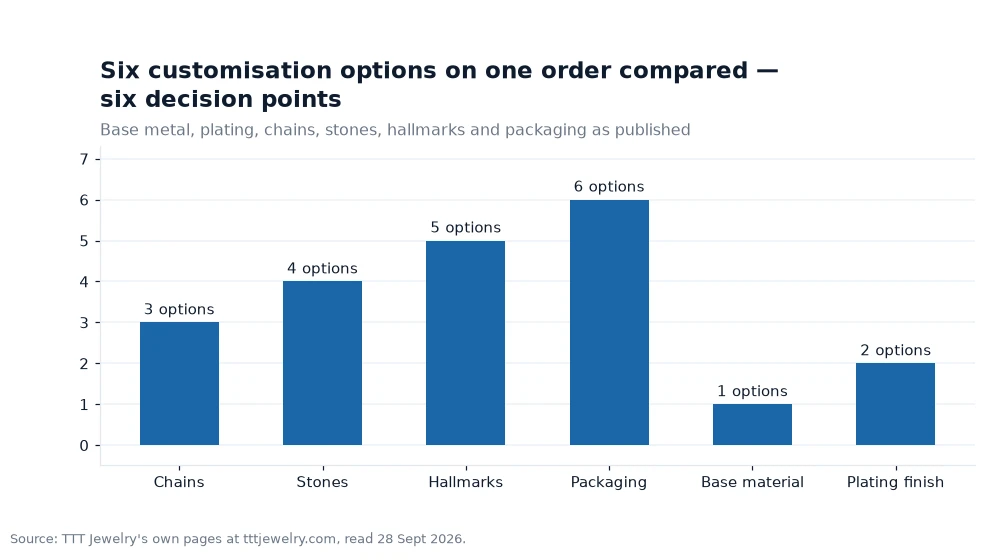
Every ODM project answers the same six questions, and answering them in the right order saves a week of back and forth. Material first, because it sets the minimum. Plating second, because it sets the look and the protection. Stones, chains, hallmarks and packaging after that, in any order the design suggests.
| Customisation group | Options published | What it locks in |
|---|---|---|
| Base material | artisan brass with recycled content, 925 silver and stainless work | The minimum and the tooling route |
| Plating and finish | 14K, 18K, 24K gold, rhodium, e-coating, PVD | Colour, wear behaviour and cost |
| Chains and findings | Listed with the jewellery | How the piece hangs and closes |
| Stones and accents | Natural stones, freshwater pearls | Setting time inside the sample window |
| Logo and hallmarks | Laser engraving, 316L on stainless, the S925 hallmark and an 18KGP mark on plated work | Branding and purity marking |
| Packaging | Five lines, from logo tags to barcode labels | Whether the piece is retail-ready |
Base material first, because it sets the minimum
For a small label the material decision is a budgeting decision. At 50 pieces per design, a first collection of four silver designs is 4 × 50 = 200 pieces; the same four designs in artisan eco-brass start at 400. Silver buys breadth of range, brass buys a lower unit cost on a plated look, and stainless steel at 100+ pieces buys wear resistance and water tolerance.
None of those is automatically right. What matters is choosing before the CAD drawing is made, because the drawing is dimensioned for a metal rather than for an idea.
Plating and the anti-tarnish question
Four finishes are published: 14K, 18K and 24K gold, and rhodium. On top of that, silver and brass are sealed with a protective anti-tarnish e-coat, while stainless work gets PVD vacuum plating.
For a boutique selling online, that second layer is the one that decides returns. A plated piece sold without protection tarnishes in a drawer; the same piece with an e-coating survives the shelf life a small brand actually has. Ask which coating is applied rather than which colour is offered.
Stones, chains and findings
Stones and accents cover natural stones and freshwater pearls, and they are the main reason a sampling window runs long, because setting is a bench operation that cannot be rushed or parallelised. Every extra stone pass adds its own slot inside the 25–30 days.
Chains and findings are cheaper to change and easier to underestimate. A pendant that swings badly is usually a finding question rather than a design question, and the answer costs a line on the brief rather than a new drawing.
Hallmarks: S925, 316L and 18KGP
Purity marks are published per material: S925 for 925 sterling silver, 316L for stainless steel and 18KGP for gold-plated pieces. They are laser engraved during production alongside your own logo, which means the mark and the brand are applied in the same operation.
Two practical consequences follow. First, the hallmark needs a flat, visible surface, so it belongs in the CAD review rather than the packing list. Second, the mark is a materials statement, so it should match the base you actually ordered — a plated brass piece marked as silver would be a compliance problem, not a branding choice.
Packaging is what makes a piece retail
Five packaging lines are published: microfiber or velvet pouches, foil-stamped boxes, display cards with backing, metal logo tags and barcode labels. For a boutique, the difference between a piece that photographs well and one that sells is usually the backing card and the tag, not the metal.
Decide packaging while the sample is being built rather than after. It runs on a packing bench, not a casting bench, so it can move in parallel — but only if the artwork arrives in time. A full service jewelry OEM manufacturer will usually ask for it at the sample stage for exactly this reason.
Worked example: six options with three locked
Take the six customisation groups and assume a boutique fixes the three that carry cost: base material, plating finish and packaging. The three left open are chains, stones and hallmarks, so 6 − 3 = 3 groups are still moving while the sample is being built.
Convert that into order size and the stakes become visible. A first collection of four silver designs at the published 50-piece minimum is 200 pieces; add one brass design at 100 pieces and the same season is 300 pieces. The subtraction and the multiplication are my arithmetic; the six groups and the 50 / 100 piece minimums are published.
What to put in writing with a small brand
Three sentences protect a first order. One: the material and the minimum per design. Two: the plating stack and the protective coating. Three: the packaging lines and who owns the artwork. Everything else can be settled in the consultation, which is where feasibility, material selection and cost structure are worked out before drawing begins.
Boutiques that skip those three sentences usually spend the sample window re-deciding the brief, which is the one thing that reliably adds time to a published schedule.
Where a boutique collection usually goes wrong
Two failure modes account for most difficult first seasons. Ordering too narrow a range at too great a depth — four designs at 50 pieces each outperforms one design at 200 pieces when nothing is proven yet. And treating packaging as a warehouse decision, which leaves a label with jewellery it cannot photograph or label properly until a second order arrives.
Both are fixed by the same habit: decide the small things at the same time as the big ones, because the minimum is charged per design rather than per collection.
Frequently asked questions
Can a boutique label order fewer than 100 pieces?
Yes, in silver. artisan eco-brass, 925 silver and 316L stainless steel at 100+.
Does an ODM collection stay exclusive to my label?
Yes. A developed collection is exclusive to your brand, and the moulds, CAD files and design set are covered by a 100% NDA and are not resold.
How long does a first boutique order take?
Plan on under 48 hours for the CAD stage, 25–30 days for the master sample and 3–4 weeks for production, plus your own approval time at each gate.
Planning the first season as a range, not a piece
A boutique's advantage is speed of assortment, not volume per shape. That argues for sampling several designs once, in the metal with the lowest entry point, then reordering the winners and moving the rest into plated ranges later as demand becomes visible.
It also argues for picking a partner whose minimums are published rather than negotiated. If the first range is likely to sit in silver, the sterling silver manufacturing pages set out the finishing and protection steps, and for a lower unit cost on plated pieces the custom brass jewelry line is the natural second range.
Most of what this piece relies on — the eight-step production route plus the master-sample benchmark and laser engraving for logos — is set out on the factory's own site via tttjewelry.com, as of 28 Sept 2026. The same pages carry the ISO 9001:2015 quality-system reference. The unit conversions are my own rather than the manufacturer's [1]