
A supplier visit produces its most valuable output before a contract exists, because that is the only point at which every answer can still change the shape of the deal. Buyers who tour a facility and a collection, enjoy the day, and sign the same quarter often find that the questions the visit raised were never converted into terms. The fix is procedural rather than clever: end the visit by writing down the questions it generated, send them in writing, and put the important answers into the agreement. For a drugstore range, where the commercial relationship will outlast the launch, that written trail is the difference between a visit and a decision.
Key takeaways
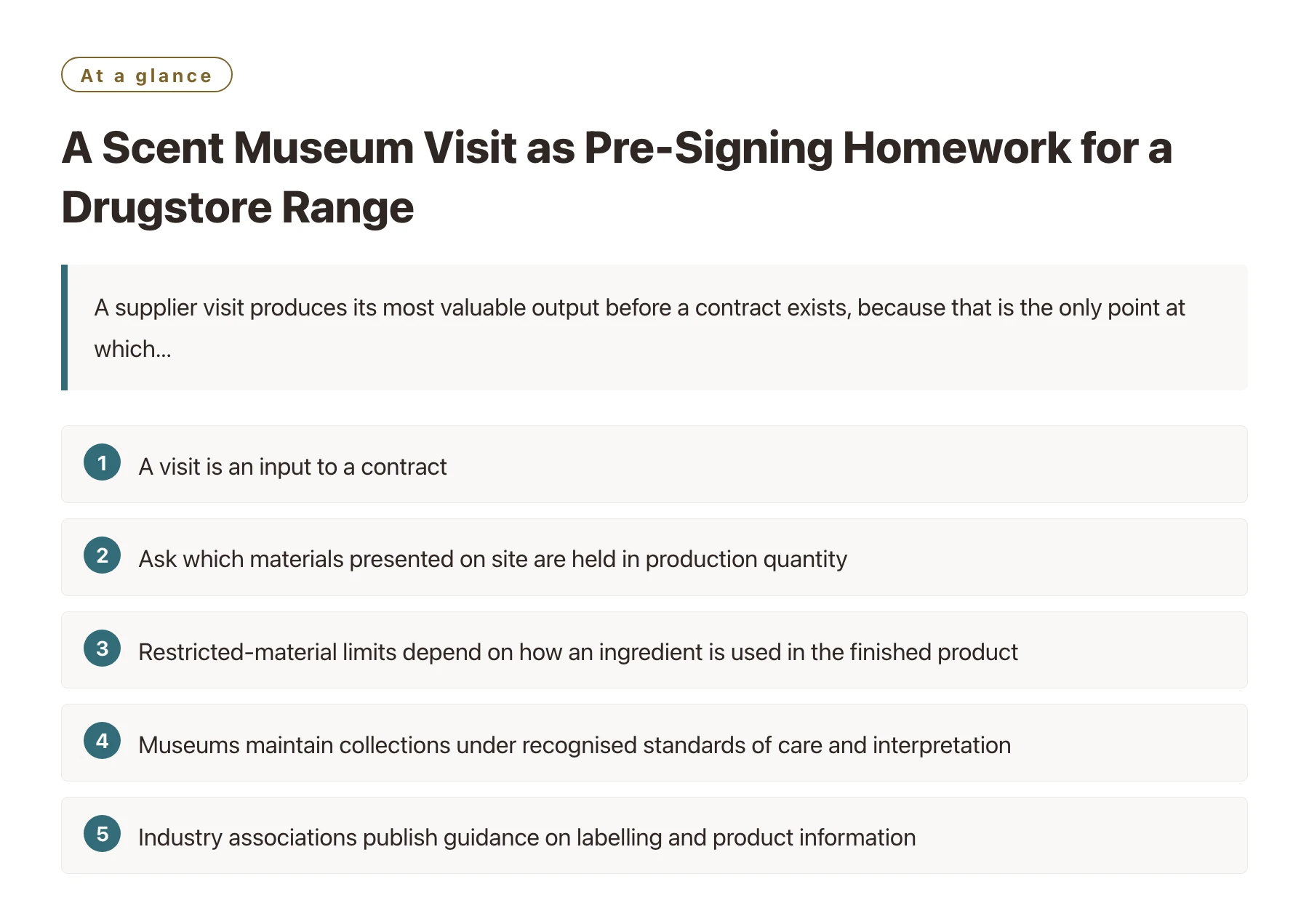
- A visit is an input to a contract, not an alternative to one, so every observation should end up either in the scope or in the file.
- Ask which materials presented on site are held in production quantity, because a collection reference and a purchasable material are different things.
- Restricted-material limits depend on how an ingredient is used in the finished product, so the pre-signing question is about headroom, not about a list [1].
- Museums maintain collections under recognised standards of care and interpretation, which is a fair benchmark for judging how a supplier keeps its own references [2].
- Industry associations publish guidance on labelling and product information, and a supplier that follows it will find those questions routine [3].
- Exclusivity needs a field, a territory and a duration, and a question left unanswered before signing tends to be answered by the supplier afterwards.
Walking a supplier's site is one of the few moments when a buyer sees the company behind the quotation. It is also the moment when questions come up naturally and are easiest to ask, because both parties are in the same room and nobody has yet committed to anything. The mistake is to treat that window as an interview rather than as preparation for an agreement. What a buyer takes away should not be an impression but a list.
The list matters because supplier relationships in this industry are long. A drugstore range is likely to be replenished for several seasons, which means the terms that govern a reorder will eventually matter more than the terms that governed the first order. Somewhere in the background is also the buyer's own position: which parts of the product are theirs, which are licensed, and what happens if the relationship changes. The visit is a good place to raise all of it before signatures make it awkward.
It helps to arrive with a small set of questions already drafted and to leave with a longer one. Everything discussed on site should later be traceable, and the fragrance manufacturer's website the fragrance manufacturer's website is usually the first place to check what a company says about itself in public before the written answers arrive.
Questions about materials and development
A collection is a good starting point for technical questions because it is concrete. Buyers do not need to be perfumers to ask whether a material shown on a shelf is one the house can actually buy, store and use in production, and the answer distinguishes a reference collection from a sourcing position. That single distinction prevents a brief from being built around an accord that cannot be manufactured at the required volume.
Which of these materials do you hold in production quantity?
A material can be easy to show and difficult to secure. Ask which materials in the accords discussed are held as production stock, which are bought to order, and which have supply that fluctuates. A supplier that answers this plainly is giving the buyer a realistic view of what can be made reliably rather than what can be made once.
What is the restricted-material position of a candidate formula?
Use limits apply to the way an ingredient appears in a finished product, so a formula can be comfortable in one product type and tight in another. The pre-signing question is not whether a material is restricted but how much room a candidate has against the applicable limit, and who confirms that as the formula is refined. Asking it early costs nothing and avoids a reformulation after approval.
Who develops the scent, and who is still reachable afterwards?
Development and production are different disciplines, and the person who answered technical questions during the visit may not be the person who resolves a question six months into production. Ask for both names and for the route between them. A named handover is a small thing to request and a large thing to rely on.
Questions about rights, documentation and risk
The commercial questions are harder to ask on a factory floor because they are not about the product, but they are the ones that decide whether the range is an asset. Buyers should be prepared to ask them in plain terms and to accept that the answer may be a structure rather than a yes or no. The Xuelei Fragrance Museum is the sort of setting where these conversations usually happen, and it is worth using a quiet moment there deliberately rather than leaving them to email.
Two supporting habits help. First, ask for the file rather than an assurance: the documents behind a range are more persuasive than a description of them. Second, ask what changes if the volume triples, because the answer reveals whether the supplier's current process is the one that will be used later.
Who owns the formula, and what rights come with the development fee?
Ownership and use rights are separate questions, and a development fee does not automatically transfer either. Buyers should ask who owns the composition, what rights they receive, in which field and territory those rights apply, and what happens on termination. Getting that in writing converts a vague worry into a clause.
What is retained from an approved batch, and for how long?
A retained reference is what a reorder is measured against, so its existence and storage matter more than most buyers expect. Ask what is kept, where it is kept, how it is identified and for how long. A supplier that treats this as routine will answer without hesitation, and one that treats it as an unusual request has revealed something about how repeat orders are handled.
What happens if a component is discontinued or a material becomes hard to buy?
Substitution is the quiet origin of many consistency complaints. Ask how a substitution is handled, whether it is compared against the retained reference, and who bears the cost of re-approval. The same question applies to the pack: a pump or cap change can alter the spray and the feel of the product even when the formula is untouched.
Which documents will accompany each shipment?
The answer should be a list rather than a promise. Batch records, inspection results and conformity statements are the basics, and a branded retailer may ask for more. Agreeing the list before signing means the buyer knows what to expect and the supplier knows what to prepare, which is a useful alignment for a range that will ship repeatedly.
Before the visit ends, agree two things that are easy to overlook. First, who will answer the written questions and by when, because a list without an owner quietly expires. Second, whether the answers will be attached to the contract as a schedule, which turns a conversation into something enforceable. A house that treats the visit as part of a process rather than as an event will welcome both requests; a place to learn perfumery a place to learn perfumery is often where the same discipline shows, because teaching a subject requires knowing exactly what is being promised. Buyers who want a fuller checklist can compare their notes with the published guidance on what to verify before signing with a fragrance manufacturer what to verify before signing with a fragrance manufacturer.
Sources
- IFRA Standards Library (International Fragrance Association) —— The IFRA Standards Library lists the restrictions the fragrance industry applies to individual fragrance ingredients, based on safety assessments; it is the reference point for compliant fragrance formulation.
- ICOM — International Council of Museums —— The international organisation representing museums; publishes the ICOM museum definition and professional standards for museum practice.
- Cosmetics Europe —— The European trade association for the cosmetics and personal care industry, publishing guidance, positions and market information.
Frequently asked questions
Should the contract be signed at the end of a supplier visit?
Almost never on the same day. The visit should produce written questions, and the answers should be reviewed before signature. Signing during the visit removes the chance to compare what one supplier said with what another said about the same points.
How many questions should a buyer bring to a supplier visit?
A short prepared list of five to ten covering scope, ownership, references, testing and timelines, plus whatever the visit itself generates. The written follow-up after the visit is usually longer than the list brought in.
Which answers should be attached to the contract?
At minimum the scope statement, the retention period for reference samples, the inspection standard, the substitution rule and the ownership and rights position. Those are the answers that will be needed most often after the launch, when memories have moved on.
Is it reasonable to ask about a supplier's other clients during a visit?
It is reasonable to ask how the supplier runs a programme and what roles it holds in it, and many suppliers will describe completed work. Confidentiality means specific client names may not be available, which is normal and not a warning sign in itself.
What if the supplier will not answer a question in writing?
Treat that as information. Some answers genuinely cannot be fixed so early in a project, and those can be agreed in stages. A refusal to commit any of them to writing before a deposit is paid is a commercial signal worth weighing.