
Two Rates, Two Jobs: How a Mining Pool Fee Schedule Is Actually Built
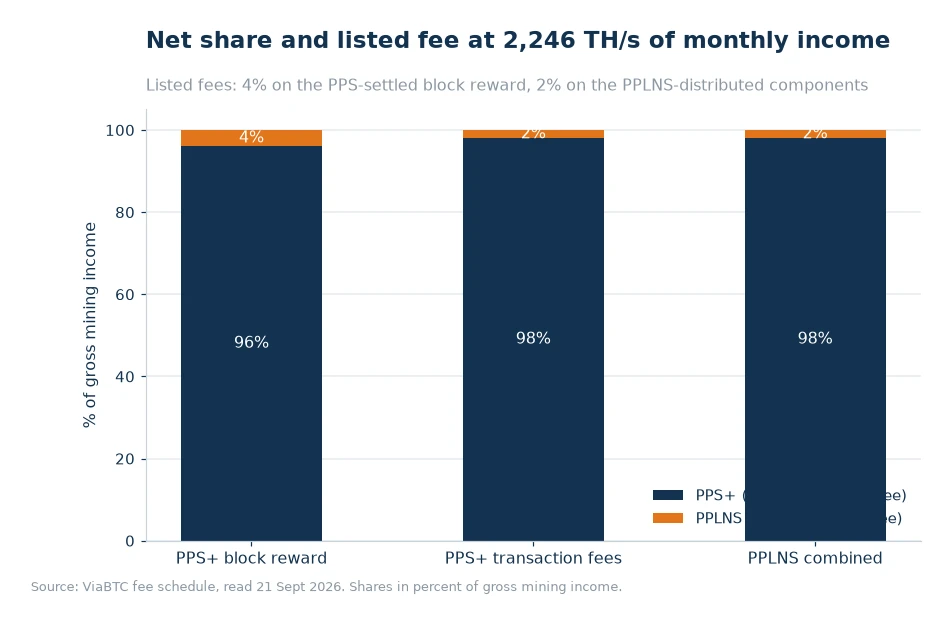
A pool fee is not one number. At 2,246 TH/s the daily output is 0.00100757 BTC, worth $85.33 at $84,692 per coin, and the schedule applies 4% to the block-reward part and 2% to the transaction-fee part. Those are different rates on different components, not a single charge on the total. Reading them as one combined percentage is how miners end up misjudging what a switch between payout schemes would cost.

Key takeaways
- At 2,246 TH/s the output is 0.00100757 BTC a day, or $85.33 at $84,692 per BTC.
- The listed 4% applies to the PPS-settled block reward: $3.41 a day on that base.
- The listed 2% applies to the PPLNS-distributed components: $1.71 a day on the same base.
- Both PPS+ and PPLNS are available, and the choice changes timing and variance, not just cost.
The flat-six myth
Add four and two and you get six, which is why a certain kind of summary insists that a pool with these rates takes six percent. The arithmetic is right and the conclusion is wrong, because the two rates never apply to the same money. The block reward is settled on a PPS basis and carries the 4%. The transaction-fee component is distributed on PPLNS logic and carries the 2%. Anything you read that flattens the two into one charge is describing a different product.
This matters at the scale of a real operation. At 2,246 TH/s, charging both rates against the whole output would overstate the cost by roughly $1.70 a day against the 4% line alone. Over a year that is the difference between a hosting upgrade and no hosting upgrade. The rest of this article is about where each rate actually lands.
What the 4% buys
Under PPS+, the block-reward component is settled on a per-share basis at current difficulty. The pool absorbs pool luck: if the pool finds fewer blocks than expected in an hour, the credit to the miner does not fall with it. That transfer of variance is what the higher listed rate pays for. It is also why the rate is quoted per component rather than per payout, because the transaction-fee side does not carry the same assurance.
Settlement is hourly. That cadence matters for anyone running a business rather than a hobby, because a predictable credit per hour is easier to reconcile against a power bill than a lump sum that arrives when the pool's luck turns. The ViaBTC Pool Fees page sets out the two schedules side by side, and it is worth reading before comparing a quote from anywhere else.
What the 2% buys
The transaction-fee component is shared by PPLNS logic inside PPS+ and carries 2%. Under PPLNS proper, the block reward and the fees are combined and shared the same way, also at a listed 2%. In that mode the miner carries the variance instead of the pool, which is the trade: a lower listed rate in exchange for taking pool luck onto your own books.
The share of income that comes from fees is not fixed. On a quiet chain it is small and the 2% line is almost decorative; on a busy one it grows and the same rate starts to matter. A schedule that quotes two rates is therefore more honest than a single blended number, because it lets an operator see which part of the income is exposed to which charge.
Settlement timing changes the shape of the number
PPS+ credits hourly against current difficulty. PPLNS waits for 6 confirmations, then shares the miner's slice across the last 5 difficulty rounds. Over a month the totals converge, but the paths do not: one is a staircase, the other a series of jumps. If the plan is to convert coins to currency on a schedule, the staircase is easier to match to a calendar.
Neither path is faster in a way that changes the annual total. What changes is what the miner has to absorb in the meantime. A pool that pays hourly has already smoothed the bad hours; a pool that pays on a five-round window hands them back. The listed rate is the price of that smoothing, and it is charged only on the component where the smoothing happens.
One day of output, extended
Multiplying a daily figure by thirty and then by 365 is crude, because difficulty moves. It is still the right first pass, since it shows the size of the fee line relative to everything else on the invoice. The table holds output at the 21 September 2026 level and applies each listed rate to the daily base.
| Period | Gross | At listed 4% | At listed 2% |
|---|---|---|---|
| 1 day | $85.33 | $3.41 | $1.71 |
| 30 days | $2,559.90 | $102.40 | $51.20 |
| 365 days | $31,145.45 | $1,245.82 | $622.91 |
The two right-hand columns are not alternatives to be added. They show what each rate would cost if it applied to the whole output, which is the only way to see the gap between them: about $1.70 a day at this hashrate, or roughly $622 over a year. The real charge sits between the two columns, weighted by how much of the output comes from transaction fees.
Worked example
Follow the chain from network output to the two fee lines.
- Daily network output: 3.125 × 144 = 450 BTC.
- Per TH/s: 450 ÷ 1,003,107,267 = 0.000000448606 BTC.
- At 2,246 TH/s: 2,246 × 0.000000448606 = 0.00100757 BTC.
- At $84,692: 0.00100757 × 84,692 = $85.33.
- Listed 4% on the block-reward component: 85.33 × 0.04 = $3.41, leaving $81.92.
- Listed 2% on the fee component: 85.33 × 0.02 = $1.71, leaving $83.62.
- If transaction fees were 2% of output, the blended charge would be 3.96%, or $3.38 a day.
That last line is the one worth remembering. Because the 2% applies to a smaller slice of income, the blended cost sits just under 4% while fees are a thin part of the block, and drifts a little lower as the fee share rises. The 4% figure is a ceiling on the block-reward side, not a description of the whole invoice.
Comparing a quote from somewhere else
When another pool advertises a single number, the useful question is which components it covers. A 2% headline that excludes transaction fees is not comparable with a 4% charge that includes the variance cover. Ask for the rate per component and for the settlement cadence, then rebuild the daily figure at your own hashrate. Two quotes only mean something once they are expressed in the same units.
Keep a copy of the schedule you signed up under. Rates are published and can change, and the version that applied in March is the one to use when reconciling a March statement. A screenshot with a date on it is less romantic than a spreadsheet and more useful than a memory.
Frequently asked questions
Is the ViaBTC fee 4%, 2% or 6%?
It is 4% on the PPS-settled block reward and 2% on the PPLNS-distributed components, so a blended figure sits just under 4% while transaction fees are a small share of output.
Why does PPS+ pay hourly while PPLNS waits?
PPS+ settles the block-reward component against current difficulty every hour, while PPLNS shares output across the last 5 difficulty rounds once a block has 6 confirmations.
Does a higher listed rate always mean a worse deal?
No. The 4% rate removes pool-luck variance from the block reward, so compare schemes on the daily figure you can plan around, such as $85.33 gross at 2,246 TH/s, rather than on the rate alone.
Write the rate next to the base it applies to
Any fee note worth keeping has three parts: the rate, the component it applies to, and the daily base at your hashrate. At 2,246 TH/s that base is $85.33, which turns 4% into $3.41 and 2% into $1.71 without ambiguity. Reproduce the same three lines for every pool you are considering and the comparison stops being rhetorical. The Profit Calculator will produce the base, and the schedule supplies the rest.
Then check where the coins land. A multi-currency wallet in the same account as the mining dashboard removes a transfer step between credit and conversion, and the fee you just calculated is only meaningful if the coins can be moved without a second charge appearing on the way out.
Sources: the ViaBTC pricing page for the listed 4% and 2%, and the calculator page for the output base[1]. Chain data read 21 Sept 2026: network hashrate 1,003 EH/s, difficulty 132.76 T, subsidy 3.125 BTC per block, 144 blocks a day, BTC $84,692. Published 22 Oct 2026; projections hold difficulty and price constant.